
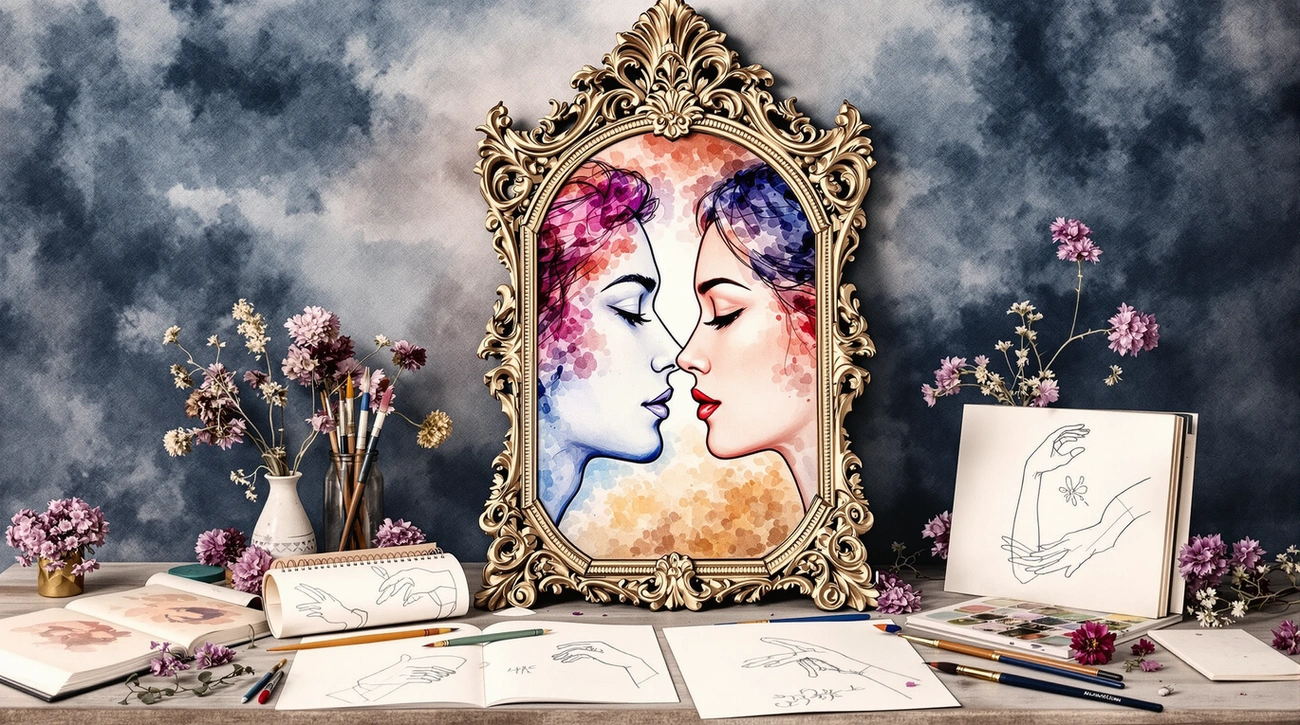
Why Your Sketches Hold More Secrets Than Your Diary
Ever wondered why you feel compelled to doodle during meetings or find yourself sketching faces when you’re lost in thought? Those seemingly innocent marks on paper are doing something far more profound than you might realize. They’re speaking a language your conscious mind doesn’t even know it’s fluent in.
Thank you for reading this post, don’t forget to subscribe!Here’s what makes identity drawings so powerful: they’re like having a conversation with yourself without the usual mental censors standing guard. While we carefully curate our words and actions in daily life, our drawings slip past those filters. They reveal the raw, unedited version of who we are—including the parts we might not be ready to acknowledge.
Your Art Knows Your Desires Before You Do
Let’s talk about something most people won’t admit: sexuality isn’t just about physical attraction or bedroom activities. It’s woven into every aspect of who you are, yet society teaches us to keep these feelings locked away, especially if you’re someone who doesn’t fit conventional expectations.
This is where art becomes your secret weapon. When words fail or feel too risky, your drawings step up to the plate. Throughout history—from those ancient cave paintings that made our ancestors blush to Renaissance masterpieces hiding erotic symbolism—humans have used art to explore what society wouldn’t let them speak aloud.
Think about it: when you’re sketching, you’re not performing for anyone else. You’re having an intimate conversation between your hand and the paper. Artists often describe their work as a way to “navigate complex sexual feelings and gender identities that society might otherwise silence”. Your sketchbook becomes a safe space where taboos don’t exist.
The fascinating part? This isn’t some modern phenomenon. Different cultures and time periods have had wildly different comfort levels with sexual expression in art. Ancient societies were pretty open about it, while other eras got all buttoned-up and censorious. But throughout these shifts, artists kept finding ways to express what couldn’t be said.
Take artist Hein Digemans, who used his drawings to explore “how he would like to look and as a way to release his wish to find a mate”. His work shows how art functions as both mirror and wishbook—reflecting who we are while imagining who we could become.
The Magic Mirror You Didn’t Know You Had
Creating art is like having access to a magic mirror that shows you things about yourself you never noticed. But this isn’t some fairy tale—it’s real, and it’s happening every time you put pencil to paper.
One artist described connecting with artwork as opening “a door to our own unique experiences”. That door swings both ways. When you create, you’re not just expressing—you’re discovering.
Want proof of how sneaky this process can be? Artists constantly surprise themselves with what emerges. One creator shared drawing an “impotent figure with no arms and a malformed leg, staring ahead into some kind of revelatory space/time portal” that was never meant as a self-portrait but clearly hit “a very sensitive nerve”. Sound familiar? Those moments when your art catches you off guard are golden—they’re your unconscious mind waving hello.
Art therapists have figured out that “art-making is a powerful way to intentionally reflect on and participate in the lifelong process of identity formation”. But you don’t need a therapy degree to benefit from this. Anyone brave enough to pick up a pencil and get honest with themselves can tap into this self-knowledge.
Here’s the beautiful paradox: creating identity drawings requires vulnerability—willingness to face your fears, insecurities, and those desires you’ve been pretending don’t exist. Yet this vulnerability becomes your superpower, connecting you to your most authentic self.
Your drawings also serve as a visual diary of personal transformation. They capture moments of change that might be impossible to put into words. Think of them as snapshots of your evolving identity, creating “an effective means to explore the lifelong process of ‘becoming’”. Years later, you can look back and trace your journey—seeing patterns you missed in the moment.
What makes visual expression especially powerful is its ability to hold contradictions. While words demand clarity and definitions, your drawings can be beautifully messy and complex. This makes them perfect for exploring fluid aspects of identity—like sexuality and gender—that refuse to be neatly categorized.
Ready to start paying attention to what your art is trying to tell you?
When Your Sketches Start Spilling Secrets
“I really want the work to speak for itself.” — Rema Ghuloum, Contemporary painter, recognized for abstract works exploring identity
Your pencil knows things you don’t even realize yet. Those doodles scattered across your notebooks? They’re having conversations about your desires that your mouth never learned to speak. Every line you draw creates a secret language—one that bypasses all those polite social filters and gets straight to the good stuff.
Visual metaphors that make your heart race
Desire has this sneaky way of hiding in plain sight through symbols that would make your grandmother blush if she knew what they really meant. Artists figured out centuries ago how to make a simple rose scream passion louder than any love letter ever could.
Think about it—when you keep drawing flowers, are you really just into gardening? Those birds that keep appearing in your sketches might be more about freedom and connection than ornithology. Your unconscious mind is basically playing charades with your art supplies, and honey, it’s winning.
Here’s what gets really interesting: the red rose everyone recognizes as passion has a white lily sister that whispers about spiritual connection and innocence. But your brain already knows this dance between sacred and profane—it shows up in how you position figures close together for intimacy or pull them apart to create that aching sense of longing.
Color becomes your emotional fingerprint in these moments. Those warm reds and oranges you gravitate toward when you’re feeling spicy? Your body temperature probably rises just mixing those shades. Meanwhile, cooler blues and greens might appear when you’re seeking something more contemplative. It might be that spiritual connection your soul keeps whispering about.
Artists throughout history turned everyday objects into erotic Easter eggs. Mirrors became ways of seeing yourself through a lover’s eyes. Veils transformed into symbols of mystery between hearts. Venus and Cupid showed up as metaphors for divine attraction that society couldn’t quite silence.
Japanese artists knew something we’re still figuring out—cherry blossoms perfectly capture how love feels both eternal and heartbreakingly temporary. Different cultures developed their own secret vocabularies of desire, and your sketches are probably speaking several languages at once.
The subtle stuff that gives you away
Your art is basically a lie detector test you’re administering to yourself. The pressure you apply to paper, where shadows fall, how eyes gaze—these tiny choices reveal more about your inner world than any therapy session ever could.
Want to decode your own visual confessions? Pay attention to:
• Line pressure: Heavy, confident strokes versus light, uncertain marks—your hand knows how you really feel about what you’re drawing • Space relationships: How close figures get to each other reveals your comfort with intimacy • What keeps showing up: That symbol you draw without thinking? It’s probably obsessed with something important about your identity • What you hide: Sometimes the covered parts tell the most interesting stories
Renaissance artists literally hid love letters in their paintings—tiny initials, secret inscriptions, coded messages to their muses that art historians are still discovering. Your sketchbook might be doing the same thing, creating visual love notes to parts of yourself you haven’t met yet.
Eyes deserve special mention here because they’re basically windows with the curtains drawn back. That “gaze relationship between sitter, artist and viewer” creates this electric triangle of looking that can make you feel naked even when everyone’s fully clothed.
Even the surrealists knew how to use contradiction to explore desire’s messy complexity. Dalí’s melting clocks weren’t just about time—they captured how emotions bend and warp under passion’s heat. Magritte’s veiled lovers reminded us that even in love, complete access to another person’s interior remains beautifully impossible.
Your identity drawings work on multiple floors simultaneously—what you see on the surface is just the lobby. The real action happens in the basement levels, where your unconscious mind has been throwing the most interesting parties without sending your rational brain an invitation.
Why We Hide Our Realest Art (And What It Says About Us)
Artists have always had their secret stash. Those sketches tucked away in the back of notebooks, the drawings nobody else gets to see. Hidden identity drawings tell stories that polished gallery pieces never could—raw, unfiltered glimpses into who we really are when nobody’s watching.
The beautiful freedom of nobody watching
Here’s the thing about our hyperconnected world—every brushstroke feels like it needs an audience. But some of the most honest art happens when artists give themselves permission to create without performing. “Artists could experiment. Nobody saw your work, and there was not much at stake”.
What a gift that is! No likes to chase, no comments to manage. Just you, your materials, and whatever wants to emerge.
Private sketchbooks become sanctuaries for exploring the parts of ourselves society might find uncomfortable. Students in art studios have discovered they can express “what is hidden about themselves, contrasting with what is exposed, and how the physical and emotional interplay” when given that safe creative space.
There’s something deeply therapeutic about creating art nobody else will judge. Your nervous system relaxes when you’re drawing just for you. That meditative flow state kicks in, and suddenly you’re accessing thoughts and feelings that usually stay buried. Pretty powerful stuff, right?
Secret sensual sketches (yes, they’re everywhere)
Let’s talk about the elephant in the art room—erotic drawings. Famous artists throughout history kept private collections of sensual works they’d never dream of displaying publicly. Turner filled red leather sketchbooks with “overtly erotic and occasionally explicit” watercolors that revealed sides of him his public never saw.
Dalí had erotic sketches that showed his “classical training and skill as a draftsman” with imagery that could “rival his paintings in their technical brilliance”. Picasso’s intimate drawings were “in turn provocative and humorous, angry and tender”. Even the masters needed spaces to explore desire without society’s restrictions.
These private works serve as laboratories for sexual and sensual exploration. Turner found “erotic stimulation from indistinct arrangements of tone and color”. Contemporary artists like Bemi create intimate imagery on unconventional surfaces, bridging “the past and present, the personal and communal, and the tangible and spiritual”.
What your repeated symbols actually mean
Notice what you draw over and over again? Those recurring themes aren’t accidents. Our brains have these concept networks that “integrate and store all information pertaining to one concept, regardless of the modality of the inducing stimulus”. When you keep drawing certain symbols or themes, you’re tapping into something significant.
Hidden identity drawings work on multiple levels. The surface shows one thing, but underneath lies “a rich tapestry of meaning accessible through careful observation”. Some artists deliberately create “a kind of white space for emotions and desires” where meaning can shift and evolve.
Your brain responds differently to art that resonates with your inner world. This explains why “an image that was highly recommended by one observer was given a low recommendation by another”. We’re all decoding through our own psychological filters.
Cracking your own visual code
Ready to decode what your secret sketches are telling you? Start looking for patterns:
- Line quality: Heavy, confident strokes versus light, tentative marks
- Recurring symbols: What objects, shapes, or figures keep appearing?
- Color choices: What emotional states do your color preferences reveal?
- Spatial relationships: How do elements in your drawings relate to each other?
Pay attention to both the obvious geometric patterns and the subtler gestural meanings. Sometimes what emerges on paper surprises even you—and that’s where the real discoveries happen.
Here’s the beautiful truth: decoding your visual language takes patience and kindness toward yourself. One artist wisely asked, “How do I make peace with ‘bad’ drawings as long as they allow me to be creative?”. The answer? Value the process over perfection. Even your messiest sketches contribute to understanding who you are.
Your secret art speaks volumes. Are you ready to listen?
Your Art Becomes Your Sexual Confessional
Your pencil doesn’t lie, especially when nobody’s watching. Sexual desire pours out through every sketch, every doodle, every “accidental” curve you draw in your private moments. Think your innocent drawings are just innocent? Think again! Art becomes this wild mirror that reflects back your deepest yearnings—the stuff you’d never say out loud at a dinner party.
When your drawings spill your secrets
Here’s the thing about identity drawings—they’re terrible at keeping secrets. The intimacy between you, your pencil, and that blank paper creates this magical space where your authentic self just… shows up. No filters, no editing, just raw honesty flowing from your mind straight to your hand.
Artists working with sexual themes constantly get surprised by what tumbles out of their subconscious. Research shows that “art can be understood as an opportunity for self-exploration and a safe space for expressing sexual desire”. Your drawings become these emotional time capsules—capturing loneliness, vulnerability, hope, and those spiritual connections you crave.
Ever notice how your hand moves differently when you’re drawing something that turns you on? The pressure you apply, those sweeping gestures, the way you linger on intimate details—it all mirrors the emotional charge of longing. Your body knows what your mind won’t admit. The physical act of creating art connects directly to how we experience desire.
Different artists, different confessions. Take Aloïse Corbaz, stuck in a psychiatric hospital back in 1918. Her drawings exploded with “nudity, pregnancy, popes, princesses and queens” bursting with “feminine power and sensuality”. She created her own universe where sexuality could run free. Then there’s Fátima Calderón, whose drawings of male characters with prominent genitalia reveal sexual fascination wrapped in innocent storytelling.
Your yearning shows up everywhere—even in abstract work. Colors, forms, compositions all carry sexual energy. As researchers point out, art “unleashes and intensifies… Art is of the animal”. Your body responds to art that hits those deep longings—heart racing, skin tingling, breath catching. That’s your authentic self recognizing itself.
Playing hide and seek with your desires
Identity drawings live in this fascinating space between fantasy and confession. Every line you draw tells two stories—the one you think you’re creating and the one you’re actually revealing. Where does imagination end and truth begin? Nobody knows, and that’s exactly the point.
Your confessional art serves multiple purposes. First, it gives you emotional release—a way to process those complex sexual feelings. Second, it creates connection when others see their own hidden desires reflected in your work. Third, it challenges what society says is “acceptable” by making the invisible visible.
“The representation of genitalia and sexual arouses in Outsider Art lack the typical taboos in society”. When you draw in private, you’re free from those social performances. Take Hein Dingemans’ artwork—his male representations “can be read as exotic objects of desire and symbolic self-portraits”. Fantasy and self-representation dance together in beautiful, messy ways.
Several factors shape how directly you confess through your art:
• Historical moment (what gets you canceled versus celebrated) • Personal circumstances (who might see this and judge you)
• Artistic goals (universal appeal versus raw personal expression) • Your chosen materials (different tools enable different confessions)
Before modern movements, sexual desire hid behind metaphors and allegories. Greek and Roman figures showed idealized forms rather than personal longings. Renaissance nudes needed biblical or mythological excuses. Today’s artists often embrace more direct expressions, though symbolism and abstraction still provide protective distance.
Your sexual identity drawings become both mask and mirror—protecting you while revealing your innermost self. For those whose sexuality faces marginalization—LGBTQ+ folks, people with disabilities—these drawings become vital spaces for authentic expression. Art provides a space “where heteronormativity and patriarchal social systems are not usually recurrent as in the neurotypical world”.
The real magic? Your identity drawings translate those impossible-to-describe feelings into something tangible, creating bridges between your isolated internal world and shared human understanding.
Ready to look at your own sketches with fresh eyes? What secrets might they be telling you?
Bodies Beyond Boxes: How Artists Always Knew Gender Was Fluid
Listen—gender has never been as simple as society pretends it is. Artists figured this out thousands of years before we had fancy terms for it! Bodies tell stories that don’t fit neat little categories, and creative souls have been sketching outside the lines since… well, since there were lines to sketch outside of.
Ancient rebels who said “nope” to gender boxes
Think gender fluidity is some new trend? Keep your crusty open because history has some surprises for you!
The Egyptian pharaoh Akhenaten shows up in art with curves that would make anyone do a double-take—enlarged breasts, wide hips, features that blur what we think we know about royal masculinity. Maybe Kleinfelter’s syndrome, maybe artistic choice, maybe both. What matters? Artists saw something beyond binary and put pencil to papyrus.
Ancient Mesopotamian temples? They had priests called “gala” rocking feminine characteristics while being assigned male at birth. These weren’t mistakes or exceptions—they were celebrated parts of spiritual life. Roman “gallus” priests of goddess Cybele often used she/her pronouns despite being born male. Some chose self-castration as devotion, existing beautifully between conventional gender categories.
Here’s the thing: challenging gender norms isn’t some modern rebellion. It’s human nature finally getting the recognition it deserves.
When art got intersex representation wrong (and right)
Intersex bodies in art have a messy history—and not always the good kind of messy.
The Greco-Roman deity Hermaphroditus appears in sculptures with breasts and male genitalia. Sounds inclusive, right? Wrong. These often functioned as visual “tricks”—viewers saw what appeared female from one angle, then BAM! Male genitalia from another. Objectification disguised as art.
That problematic “hermaphrodite” term we used to throw around? Yeah, it comes from this deity. Modern artists are working overtime to reclaim intersex representation from this icky history, moving beyond the objectifying gaze that treated diverse bodies like curiosities rather than celebrations.
Today’s artists are rewriting the rules
Contemporary creators explore gender like never before! Monique Jackson uses portraiture to examine gender identity against cultural expectations. Meanwhile, v buckenham creates digital art that shows gender as a spectrum—using color and abstract forms to represent fluid identities.
Self-portraiture becomes especially powerful here. Artists like Kent Monkman (who identifies as two-spirit) reimagine historical paintings to include Indigenous and gender-diverse perspectives. These aren’t just pretty pictures—they’re visual revolutions.
Social media: Where hidden art finds its tribe
Social media changed everything for artists exploring gender identity. Platforms create communities where acceptance flows freely—often more freely than in physical spaces. This visibility literally saves lives by showing LGBTQIA2+ youth they exist in history and have bright futures ahead.
Hashtags connect artists exploring similar themes. Pinterest boards overflow with “androgynous character art,” while Instagram becomes home to transition journals and identity explorations. Supportive communities form around shared visual languages.
Don’t let anyone tell you online connection isn’t real connection. Sometimes it’s the realest connection available.
Art therapy: Your safe space to explore
Art therapy provides crucial safe spaces for gender identity exploration. The Open Studio Identity Development (OS-ID) model specifically helps adolescents recovering from mental health conditions develop identity through creative expression. This approach emphasizes supported autonomy—making personal choices in environments that nurture identity development.
Your sketchbook judges nobody. Your paintbrush doesn’t care about society’s expectations. Sometimes that’s exactly the freedom you need.
Chosen family gets the visual storytelling it deserves
Visual storytelling about chosen family carries deep historical significance for LGBTQIA2+ communities. When biological relatives reject, marginalized people create alternative family structures. Art documenting these bonds celebrates vital connections.
Community art projects allow collective visual documentation of shared experiences. These collaborative identity drawings create powerful narratives about belonging and mutual support among those building families of choice.
Because sometimes the family you choose loves you better than the family you’re born into—and that deserves to be drawn, painted, and celebrated in living color.
Decoding Your Own Visual Confessions: What Those Sketches Are Actually Telling You
“should speak for itself. I shouldn’t have to give words to it.” — Teresa Baker, Mixed-media artist, known for abstract art engaging with heritage and identity
Your art holds secrets even you didn’t know you were keeping. When you’re lost in drawing, something magical happens—your conscious mind takes a backseat while your hands spill truths onto paper. Ready to play detective with your own creative confessions?
What keeps showing up in your secret sketches?
Ever notice how you always reach for the same colors? Those warm reds and oranges you can’t resist might be your heart screaming about passion, while those cool blues could mean you’re craving some serious soul-searching time. Your color choices are basically your emotions wearing disguises!
Here’s something wild: where you place things in your drawings tells a story too. Tiny figures hiding in corners? That might be your inner voice whispering about feeling invisible. Bold, center-stage subjects? Hello, confidence! Your subconscious is literally directing the show.
Pay attention to your lines—they’re gossiping about your feelings! Those jagged, scratchy marks might be anxiety making guest appearances, while smooth, flowing curves suggest you’re riding some peaceful waves. The pressure you use matters too. Heavy, determined strokes versus whisper-light touches? Your certainty levels are on full display.
Circles and mandala-like drawings deserve special attention. These geometric beauties often represent your journey toward self-integration—they’re visual diaries of “who you are” meeting “who you’re becoming.” The way you fill these sacred spaces reveals how you see yourself in the world.
How to become your own art therapist
Want to crack your personal visual code? Give your drawings some breathing room first. Stash them away for a few days, then come back with fresh eyes. It’s like meeting an old friend—you’ll notice things that completely escaped you before.
Try this fun trick: flip your drawings upside down or snap photos of them. Suddenly, compositional secrets jump out! Elements you never noticed start waving hello, and patterns become crystal clear.
Keep a little art diary—nothing fancy, just jot down what you see and how it makes you feel. Over time, you’ll spot recurring themes that reveal your deepest preoccupations. It’s like having ongoing therapy sessions with your creative self.
Remember, this isn’t about judging your work or getting harsh with yourself. Think of it as curious exploration, like discovering a hidden room in your own house. Your art is holding up a mirror, showing not just who you are right now, but glimpses of who you’re growing into.
What patterns are you noticing in your own work? Keep your crusty open—your sketches might surprise you with what they’re brave enough to reveal!
What’s Really Going On in Your Brain When You Draw
Creating those secret sketches isn’t just artistic expression—your mind is doing some seriously fascinating psychological work behind the scenes. This whole process unlocks both what you mean to express and what your subconscious desperately wants to reveal. Pretty wild how art becomes your personal therapy session, right?
Your pencil becomes your therapist
Here’s something beautiful: that rhythmic back-and-forth motion of drawing actually soothes your nervous system. People constantly tell me they feel “productive and calm afterwards” when creating art because there are “no deadlines” and “no quota to complete.” Just you, your materials, and whatever wants to emerge.
Drawing lets you take those messy, overwhelming thoughts and transform them into something visible—something you can actually look at and understand. Instead of keeping difficult emotions locked inside, you’re giving them shape and form. This creates a sense of control over feelings that might otherwise consume you completely.
When you’re fully absorbed in creating, everything else just… disappears. Psychologists call this a “flow state”—that magical moment when anxiety fades and you find yourself in a “quiet space in a busy world.” Your art becomes your sanctuary.
When your unconscious mind takes the wheel
Here’s where things get really interesting—your unconscious mind loves to sneak messages into your art. The Surrealists figured this out ages ago, developing techniques like automatism where they’d create without conscious control. André Breton called it “pure psychic automatism… the dictation of thought in the absence of all control exercised by reason.”
Your identity drawings often contain sexual symbolism that bubbles up from deep psychological places. Throughout history, ordinary objects have transformed into sexual representations—flowers, musical instruments, even everyday items like eggbeaters become metaphors for intimate desires. These symbols appear across cultures and time periods, suggesting they tap into something universal about human psychology.
What emerges in your private sketches might surprise you. Your hand knows things your conscious mind hasn’t admitted yet.
Your Art Already Knows What You’re Thinking
Listen, your sketches have been spilling your secrets this whole time! Those doodles you thought were just random marks? They’ve been having full conversations about your desires while you weren’t paying attention. Pretty sneaky, right?
Here’s what I’ve learned from digging into this whole identity drawing thing: your art is basically your subconscious doing karaoke night—singing all the songs you’re too shy to belt out in public. Every line you draw, every color you choose, even the way you hold your pencil—it’s all connected to those deep, hidden parts of yourself that usually keep quiet during dinner parties.
Your sexuality deserves a voice, and sometimes that voice speaks through your hands before your mouth catches up. Those intimate sketches tucked away in your private sketchbook? They’re not just drawings—they’re love letters to parts of yourself that society tells you to keep hidden. But guess what? We’re not buying that narrative anymore.
Think about it: when was the last time you drew something that surprised you? When you stepped back and thought, “Whoa, where did that come from?” That’s your authentic self waving hello through your art. Those moments are pure gold because they bypass all the filters and expectations we usually carry around.
Your visual language is uniquely yours—like a fingerprint made of dreams and desires. The way you draw eyes might reveal how you see love. Your color choices could be shouting about passions you haven’t even admitted to yourself yet. Those recurring symbols that keep showing up? They’re basically your psyche’s way of leaving you breadcrumbs to follow back to your authentic self.
And here’s the beautiful part: you don’t need perfect technique to create meaningful identity art. Remember, “even imperfect drawings contribute to self-knowledge and artistic growth.” Your “messy” sketches might be the most honest things you’ve ever created.
The artists who came before us—Turner with his secret erotic watercolors, Picasso with his private intimate drawings—they understood that some art isn’t meant for gallery walls. It’s meant for your eyes, your healing, your discovery. They created safe spaces for exploring desires that the world wasn’t ready to see.
Ready to start your own visual conversation with yourself? Your journey into identity drawings doesn’t require fancy supplies or years of training—just curiosity about what your hands want to tell you when nobody’s watching.
What patterns will you discover in your own work? What secrets have your sketches been keeping? There’s only one way to find out, and it starts with picking up that pencil.
Don’t let your authentic self stay hidden in the margins. Your art is waiting to show you who you really are—messy, beautiful, complicated, and absolutely worth exploring. Keep your crusty open, and let those hidden parts of yourself finally have their say!
#IdentityDrawings #ArtAsTherapy #SexualityUnbound #AuthenticExpression
Key Takeaways
Identity drawings serve as powerful windows into our unconscious minds, revealing sexual desires and hidden aspects of ourselves that verbal communication often cannot express.
• Art bypasses conscious filters – Drawing accesses deeper psychological layers, allowing authentic self-expression without societal judgment or verbal limitations.
• Visual symbols carry sexual meaning – Lines, colors, and recurring motifs in your artwork reveal unconscious desires and emotional states about sexuality and identity.
• Private sketchbooks enable authentic exploration – Creating art away from public scrutiny provides safe spaces to explore controversial themes and forbidden desires.
• Recurring patterns reveal core identity – Repeated symbols, color choices, and compositional elements across your drawings indicate deep-seated preoccupations and aspects of self.
• Drawing functions as self-therapy – The meditative process of art-making soothes the nervous system while facilitating emotional processing and psychological healing.
The therapeutic power of identity drawings lies in their ability to transform internal struggles into visible forms that can be examined and understood from new perspectives. Whether exploring gender fluidity, sexual desire, or authentic selfhood, these intimate artworks create bridges between isolated experiences and shared human understanding, offering both personal catharsis and community connection.


Leave a Reply